
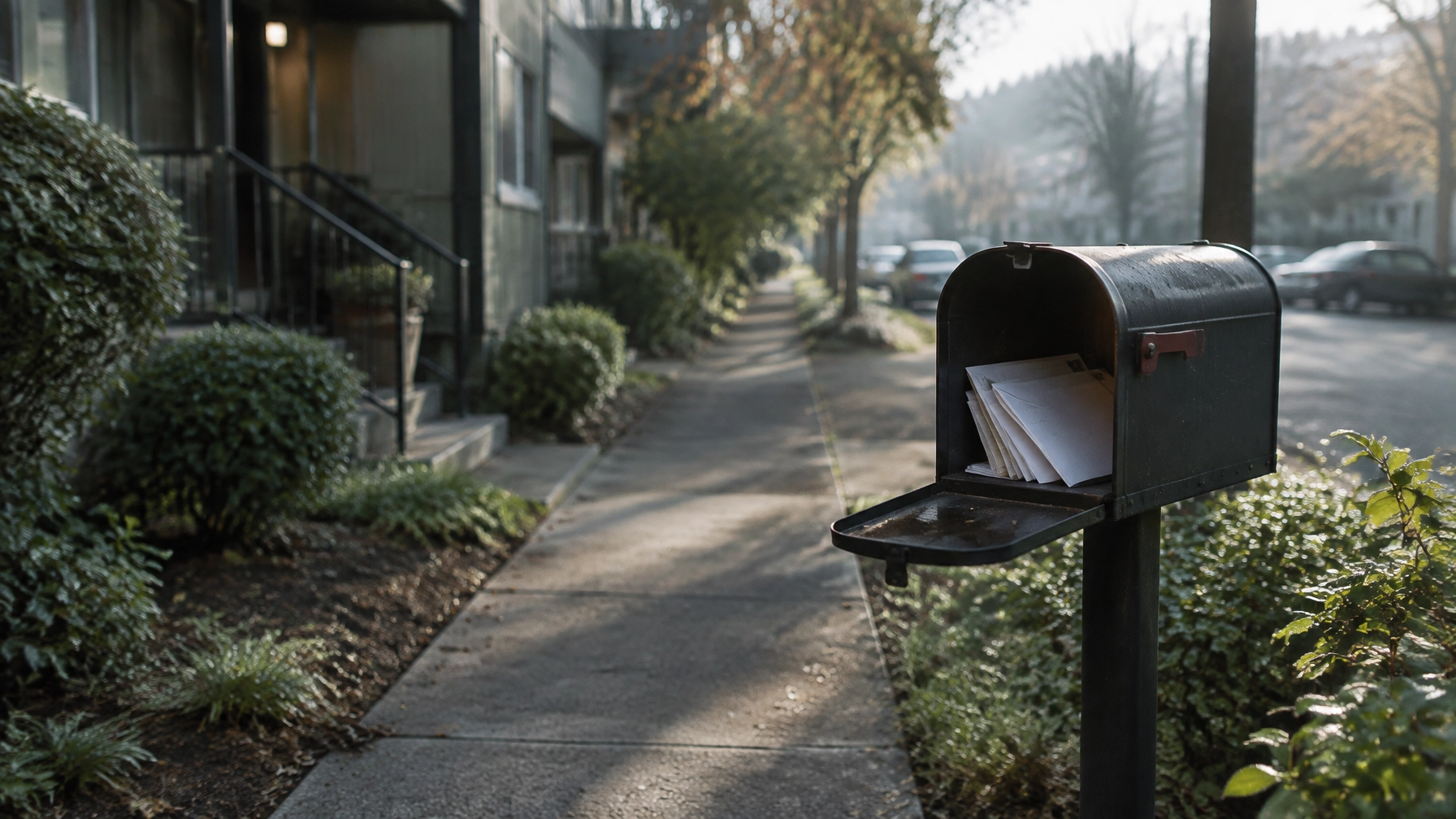
A few days after moving into my Portland apartment, I checked the mailbox.
It was full of mail for people who no longer lived there.
I stood there wondering what I was supposed to do with it. Write “return to sender”? “Not at this address”? Was there an abbreviation people normally used?
This should not have been complicated.
I grew up in the United States. I served in the U.S. Air Force. I spent much of my adult life working with American companies and clients. Yet there I was, relearning how American mail works.
The apartment already contained traces of someone else’s life. In a small way, I was arriving at an address that belonged to me while arriving in a country that still had an older version of me on file.
That small moment has become representative of something larger.
After living abroad for years, coming home does not feel quite like coming home.
It feels like learning America again.
I Have Two Versions of Normal Now
For years, Taiwan was simply where I lived.
Daily life developed its own rhythms. Getting around, buying food, paying bills, communicating with people, going to the doctor, finding a place to eat, dealing with government offices, and countless other ordinary activities gradually stopped feeling Taiwanese.
They just became normal.
That is one of the interesting things about living somewhere long enough. The unusual eventually becomes ordinary.
Then you move.
Suddenly, the things you stopped noticing become visible again.
Since returning to the United States, I have found myself asking surprisingly basic questions.
Can I turn right on a red arrow in Oregon?
What do I do with somebody else’s mail?
How does car insurance work here now?
Which neighborhoods make sense for my family?
How do I navigate school systems, healthcare, utilities, churches, transportation, and the other infrastructure that surrounds everyday life?
None of these questions is particularly profound.
Collectively, though, they have reminded me of something important:
Normal is learned.
Most of the time, I just forget that I learned it.

When I first moved to Taiwan, I had to learn a different set of ordinary things. Over time, I stopped experiencing them as lessons.
I simply knew how to move through the day.
Now the process is happening in reverse. I am not discovering an entirely foreign country, but I am encountering familiar systems with unfamiliar eyes.
That distinction matters.
I can recognize the country while still needing to relearn how to inhabit it.
Coming Home Isn’t Going Back
There is another complication.
The United States I returned to isn’t exactly the United States I left.
And I am not exactly the person who left it.
Years of living in Taiwan, traveling internationally, teaching English, working across cultures, raising children, losing jobs, changing careers, making mistakes, and reconsidering what matters have changed how I look at things.
So returning to America cannot really mean returning to my previous American life.
That life doesn’t exist anymore.
This one has to be built.
The distinction I keep coming back to is restoration versus rebuilding.
Restoration asks, “How do I get my old life back?”
Rebuilding asks, “What actually belongs in the next one?”
Those are different questions.
Restoration assumes that the old arrangement is still the right one if I can only recover it. Rebuilding asks, “What actually belongs in the next one?”
That distinction matters because it’s easy to treat this transition as restoration.
Get an apartment. Buy a car. Go back to school. Find work. Establish routines. Reconstruct an American life.
But I don’t particularly want to reconstruct my old life.
I want to decide what the next one should look like.
That is less comforting than it sounds. Rebuilding requires choices, and choices close doors. I have written before about the cost of keeping my options open. Returning home has made that cost more visible.
I can keep imagining several possible futures, but I cannot live all of them at once.

The hard part is that I don’t yet know which parts of the past I am carrying forward and which I’m carrying only out of habit.
Some days, the transition feels like a reasonable experiment.
Other days, it feels disorienting and exhausting. I miss relationships, routines, food, language, and the daily life I left across the Pacific. I can be physically present in Portland and still feel that no single place is fully home. Relearning ordinary things takes energy, especially when no dramatic event explains why I feel tired.
I do not want to turn that difficulty into a lesson too quickly.
Some of it is simply hard.
Taiwan Changed What I Notice
Living abroad gives you another reference point.
That doesn’t mean Taiwan is better than the United States or the United States is better than Taiwan.
Those comparisons become tedious pretty quickly anyway.
What matters more is having experienced different ways of organizing everyday life.
Things I once accepted without thinking now generate questions.
Do I actually need this?
Why is this system designed this way?
Is this convenient because it genuinely makes life easier, or because I have organized my life around it?
Am I doing this because it makes sense for me now, or because this is simply how Americans do it?
Those are useful questions.
For example, returning to the United States quickly made owning a car a significant part of my life again. That meant researching vehicles, insurance, maintenance, warranties, financing, and driving rules.
In Taiwan, transportation occupied a very different place in my daily life.
Neither experience provides a universal answer about how people should live. Portland isn’t Taipei, and my circumstances here aren’t the same as they were there.
But having lived both ways makes the assumptions easier to see.
And once I can see an assumption, I can decide whether to keep it.

I have also started trying to separate what I know from what I infer and what I prefer.
What I know might be simple: a car is useful for my current family responsibilities, or a particular system works differently in Oregon than it did in Taiwan.
What I infer is the story I build around that fact: that I must own a certain kind of vehicle, live in a certain neighborhood, or organize my time in a certain way.
What I prefer is separate again.
I might prefer less complexity, more flexibility, or a way of living that requires fewer possessions and obligations.
Keeping those categories apart helps me avoid treating my assumptions as facts. It also supports the kind of simplification I have been trying to practice, rather than keeping everything simply because I might need it someday.
The point is not to reject every American habit.
The point is to choose more consciously.
Even Belonging Feels Different
There is also a stranger question underneath all of this:
Where is home?
America is home.
Taiwan is also home.
Those statements no longer seem contradictory to me.
Recently, I have been looking for ways to maintain some of the life I developed in Taiwan while building this one in Portland. That includes something as simple as finding opportunities to continue using Mandarin.
It also includes relationships, habits, food, expectations, and ways of seeing the world that don’t disappear because my address changed.

I don’t think I need to choose between identities.
Living internationally for so long has made belonging feel less like picking one place and more like carrying parts of several places with me.
The interesting question is what I choose to carry.
Some things are connected to purpose. They help me remember what kind of life I am trying to build.
Some things are principles. They shape how I make decisions when situations change.
Some things are values. They tell me how I want to treat people, where I want to spend my attention, and how I want to participate in the places where I live.
Those categories do not remove uncertainty. They give me something to return to when the details become confusing. I keep finding that purpose, principles, and values are more useful than trying to create a perfect identity statement.
I can belong to more than one place without pretending that the experience is effortless.
Relearning America Deliberately
There is an advantage to finding your own country slightly unfamiliar.
It forces me to pay attention.
When everything feels normal, it is easy to live by default.
I buy what people around me buy. I organize my life the way people around me organize theirs. I accept systems because they are familiar. I accumulate things because everyone else accumulates them.
Living elsewhere interrupted some of those assumptions.
Returning lets me avoid automatically restoring them.
I am building a home in Portland. I am returning to school. I am learning about microelectronics and equipment after decades spent largely in knowledge work. I am figuring out what kind of work I want to do next.
That work might take me in directions I cannot clearly name yet. School is exploration, not proof that I have arrived at a new profession. I am learning what fits, what does not, and what kind of contribution might be sustainable.
I am also establishing new routines with family while maintaining relationships and connections across the Pacific.
I don’t know much yet.
That is probably appropriate.
I have sometimes wanted uncertainty to resolve itself before I make a decision. But some decisions only become clearer after I live with them for a while. As I have written about choices that don’t offer a clean answer, I am learning that deliberate living doesn’t mean finding certainty first.
It means making the next choice with the information, capacity, and principles I actually have.
This isn’t really a return to an earlier life.
It is another experiment in living deliberately.
Taiwan taught me that what feels normal is often just what I have become accustomed to.
America is reminding me of the same thing.
For the next week, when something feels obvious, pause and ask: Is this what I know, what I infer, or what I prefer?
That question will not tell me exactly where I belong.
It may help me notice what I am building.
Now that I have experienced different ways of living, which parts do I consciously choose for the life I am building next?
Leave a Reply
You must be logged in to post a comment.