
What grocery discounts, home cooking, and a $31 tray of sashimi taught me about value.
Saturday night, I walked out of Safeway with $168.53 worth of groceries for $80.33. According to the receipt, I’d saved $88.20, or 52%.
That’s a pretty satisfying number, especially when money is tight.
But those savings didn’t come easily. I spent a lot of time walking through the aisles, comparing products, checking prices, and figuring out which discounts actually applied. It was less a shopping trip and more an exercise in making deliberate choices about what we needed, wanted, and could reasonably afford.
And I learned a few things along the way.
A Discount Doesn’t Necessarily Mean Good Value
I’ve become more flexible about what I buy. Rather than walking into a store determined to purchase a particular brand or product, I look at what’s available and what offers the best value.
That doesn’t mean everything is negotiable. I still prefer organic, natural, lower-preservative, and healthier alternatives when practical. Dietary requirements matter, too. But when the differences between products aren’t particularly important, I’m willing to choose based on value rather than familiarity.
Even then, shopping discounts can be misleading.
Take a box of Lucky Charms. A smaller box might have a dollar-off coupon, but that doesn’t automatically make it a better purchase than a larger box without the discount. What matters is the price per ounce, not how much the store says I’m saving.
The same problem appeared with Barilla pasta. The advertisement seemed to include gluten-free pasta in the promotion. But when I looked at the products in the store, the gluten-free spaghetti had a separate sale price and still appeared to carry a premium.
I had to look beyond the advertisement to understand what I would actually pay for the product I wanted.
Then there was the question of stacking discounts.
Safeway has member prices, digital coupons, manufacturer promotions, and basket discounts based on how much you spend. Some work together. Others have restrictions that aren’t always obvious.
I wasn’t entirely sure what would happen until I checked out.
Fortunately, the discounts worked out rather well. My receipt showed $37.20 in member savings, $45 in basket savings, and another $6 in For U savings.
Still, the experience reminded me that a percentage saved isn’t necessarily the same as getting good value. The real comparison is what I paid for something I actually needed versus what I would reasonably have paid elsewhere.
Finding a Balance Between Safeway and Costco

I’m beginning to develop a fairly simple approach.
If something I need is on sale at Safeway, and its price is comparable to or better than Costco, I’ll buy it at Safeway.
If I need a larger quantity, or Costco offers a better price for a comparable product, I’ll buy it there instead.
Neither store is automatically the better choice.
Costco’s larger packages can offer excellent value, but only if we use what we buy. A lower unit price doesn’t help much if we buy to waste or if we buy more than we need, using money that could be useful elsewhere.
Likewise, Safeway’s discounts are only worthwhile when they apply to products we actually want or need.
I’m not trying to become an expert coupon collector. I’m trying to develop better shopping habits that make our money go further without having to reconsider every purchase from scratch.
Of course, there’s another cost to all this: time.
Walking every aisle, comparing package sizes, checking ingredients, and figuring out promotions takes effort. I could certainly have finished my shopping faster if I’d simply grabbed familiar products and headed to the register.
So was saving $88.20 worth the additional time?
For me, absolutely.
But not simply because I saved money.
Making Room for Something Special

Recently, Sean and I enjoyed a $31 tray of fresh sashimi from Costco.
We both love sashimi, especially salmon, so $31 is a reasonable price for that amount of fish; it’s still a substantial amount for a single meal when we’re being careful about our spending.
For the same $31, I could buy frozen meat that would provide anywhere from two to eight meals, depending on what I purchased and how I prepared it.
That’s a meaningful difference.
When money is limited, it’s easy to evaluate every purchase by how many meals it provides or how long it will last. By that measure, frozen meat would probably have been the more economical choice.
But eating isn’t only about getting enough calories for the lowest possible price.
Sean and I enjoyed that sashimi together. It was something special, and we didn’t need to visit a restaurant or spend considerably more money to have the experience.
The careful grocery shopping helped make that choice possible.
I don’t think the lesson is that saving money earns us permission to enjoy something. We don’t need to justify every enjoyable experience with an equivalent sacrifice.
Rather, when we pay attention to how we spend on ordinary necessities, we can sometimes create more room for the things we genuinely value.
Eating at Home Doesn’t Have to Feel Like Missing Out

We’ve also been spending more time preparing meals at home.
Eating out has become expensive enough that even an ordinary restaurant meal can represent a significant portion of our grocery budget. And while I enjoy restaurants, I don’t want eating at home to feel like the disappointing alternative.
So we make food we actually look forward to eating.

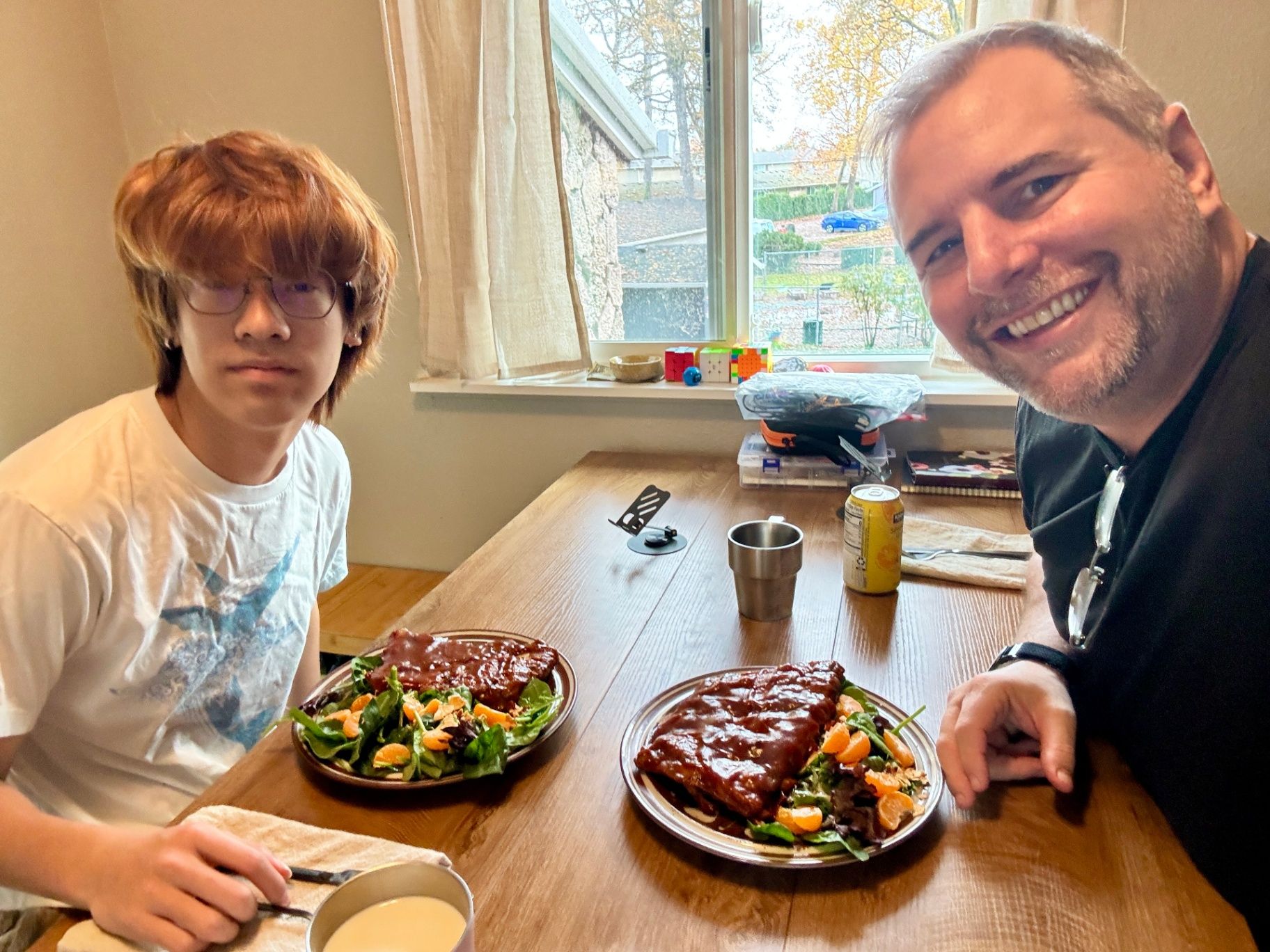
Fresh salads with greens, raspberries, and other ingredients we enjoy. Homemade pasta with shrimp. Pizza. Pancakes with tapioca pearls. Sometimes a meal is simple, and sometimes we put in a little extra effort.

Not every meal turns out perfectly. And cooking, like shopping, takes time.
But there’s something satisfying about preparing good food, sitting down together, and enjoying what we’ve made.
We don’t have to spend restaurant prices to eat well. Nor do we have to treat every meal as an exercise in maximum efficiency.
Sometimes spending a little more on a particular ingredient makes a meal considerably more enjoyable. Sometimes a less expensive alternative works just as well. And sometimes what matters most isn’t the food itself, but sharing experiences and enjoying it together.
I think cooking at home replaces every reason to visit a restaurant. There are experiences, people, and occasions that make dining out worthwhile.
But I also don’t want to feel that we’re missing out simply because we’re choosing to eat at home.
What Are We Actually Trying to Save For?
I’ve been thinking about the difference between spending less money and getting more value from the money we spend.
They’re related, but they’re not the same thing.
A 52% grocery discount looks impressive on a receipt. And I’m certainly happy to have saved $88.20 against Safeway’s listed prices.
But that number isn’t the real measure of success.
Did I buy food we’ll actually eat? Did I make reasonable choices about quality and quantity? Did I avoid spending more than necessary? And did those decisions leave us with more flexibility to enjoy our lives?
Those questions matter more to me than the discount percentage.
I’m still learning how to balance the time spent shopping, the money saved, and the quality of what we bring home. I suspect I’ll become more efficient as I get familiar with the stores, their pricing, and which promotions are worth considering.
For now, I’m satisfied with the effort.

We have groceries for the coming days, we’re making meals we enjoy, and Sean and I got to share some excellent sashimi.
I could have spent that $31 on several more meals. That would have been a perfectly reasonable choice, too.
But I’m not trying to make every dollar last as long as mathematically possible.
I’m trying to make the money we have support a life we enjoy living.
And sometimes that means spending a little longer in the grocery aisles.
Leave a Reply
You must be logged in to post a comment.