
A few weeks ago, I thought I was shopping for a $15,000 car.
The idea was pretty straightforward. Pay cash. Find something reliable enough to last three to five years. Keep my costs reasonable while I settle back into life in the United States.
I had criteria. I had a budget. I had spreadsheets, searches, and more browser tabs than any reasonable person needs for buying a used car.
I thought I knew the problem I was solving.
I didn’t.
The Question Kept Changing
My first question was essentially:
What’s the best vehicle I can buy for $15,000?
I wanted something reliable. Blind spot monitoring was important. All-wheel drive seemed useful for the Pacific Northwest. I wanted enough room for four adults and, ideally, enough space to sleep in the vehicle occasionally during a trip.
So I looked at Subarus. Mazda CX-5s. Toyota RAV4s. Nissan Rogues. Ford Escapes. Hyundai Tucsons. Kia Souls.
As I learned more, some requirements mattered less.
I decided I could live without all-wheel drive. Sleeping in the vehicle didn’t require a perfect camping setup. I could even sleep in the passenger seat if necessary.
Other considerations became more important.
I started thinking about whether the vehicle could do more than transport me from one place to another. Could I use it for rideshare work if I wanted some additional income? What would qualify for UberX? What about Comfort? Could carrying six passengers through UberXL create another useful option?
Suddenly, I wasn’t comparing the same vehicles anymore.
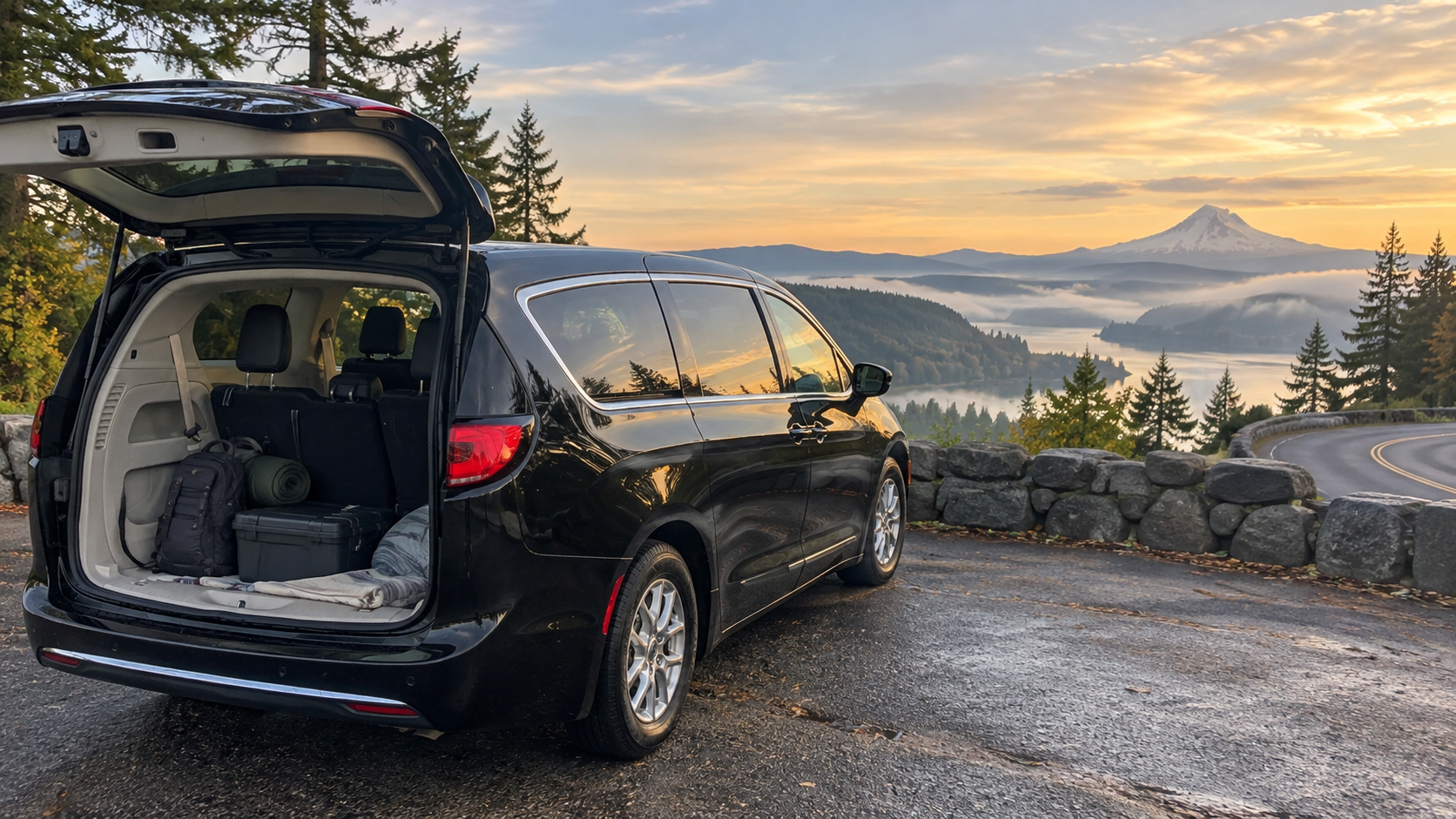
Eventually I bought a 2023 Chrysler Pacifica for $17,990 plus fees.
That wasn’t the car I had been looking for.
Which raises an uncomfortable question.
Was I responding intelligently to new information?
Or was I simply getting better at justifying spending more money?
Maybe I Started With the Wrong Question
There’s nothing wrong with setting a budget. Especially given some of my financial mistakes over the past few years, boundaries around spending matter to me.
But I had confused a constraint with a purpose.
“What can I buy for $15,000?” is a useful constraint.
It isn’t necessarily the problem.
The better question turned out to be:
What do I need this vehicle to do for me over the next several years?
That’s a different conversation.
I need transportation. I want enough room to carry family and friends comfortably. I expect to take some road trips. Reliability matters. So does reasonable maintenance.
And while I don’t know whether I’ll drive for Uber, a vehicle capable of generating some income could have value during a period when I’m rebuilding professionally.
Once the purpose changed, the reasonable choices changed with it.
But that doesn’t automatically make spending more reasonable.
That’s where things get tricky.
Possibilities Aren’t the Same as Value
It’s easy to justify buying something more expensive because it can do more.
A more powerful computer can run software I might someday use.
A larger house has rooms I might someday need.
Another degree could open doors I might someday walk through.
A minivan can carry more passengers and potentially qualify for rideshare categories I might someday drive.
“Might someday” can get expensive.
The Pacifica unquestionably gives me capabilities that some of the cheaper cars I considered didn’t.
But I also know what I actually spent.
The additional value is less certain.
Maybe I drive for Uber regularly, and the additional passenger capacity proves useful. Maybe family trips make the extra room worthwhile. Maybe I keep the Pacifica for years,s and it turns out to be a wonderfully practical choice.
Or maybe I never drive a single UberXL passenger.
An option has value only if there’s a reasonable chance I’ll use it.
Otherwise, I’ve simply paid for capability that sits in my driveway.
Checking the Story I’m Telling Myself
One practice I’ve been trying to make more deliberate in my life is checking my assumptions, ego, greed, self-interest, and desire to be right.
Car shopping provided plenty of opportunities.
Was Uber really part of my plan, or did it become part of the plan because I wanted a newer, more capable vehicle?
Was spending more protecting future flexibility, or was “flexibility” a convenient justification for exceeding my original budget?
Was I evaluating the Pacifica against what I actually needed, or had I reached the point where I wanted the Pacifica and started looking for evidence supporting the decision?
Those aren’t comfortable questions.
They’re also difficult to answer while making the decision.
We like to imagine ourselves carefully weighing evidence and reaching rational conclusions. In reality, we’re remarkably capable of deciding what we want and then constructing a very respectable argument for why we should have it.
I’m certainly capable of it.
That’s why deliberate living can’t simply mean having reasons for my choices.
I need to question the reasons too.
Keeping My Options Open
There’s another side to this.
I’m in a period of life where optionality genuinely matters.
I’m rebuilding professionally. I’m teaching. I’m applying for roles that span operations, strategy, education, customer experience, and technology. I’m considering additional technical education. I’m establishing myself in Oregon while figuring out what the next several years should look like.
I don’t know exactly what my life will look like a year from now.
That’s not necessarily a problem.
But it changes how I think about decisions.
When the future is reasonably predictable, optimization makes sense. Choose what does the known job well.
When the future is less certain, flexibility becomes more valuable.
A choice that leaves several reasonable paths available can sometimes be worth more than one optimized around a single outcome.
That’s what attracted me to the Pacifica.
It solves today’s transportation problem while leaving some additional possibilities available tomorrow.
Still, optionality isn’t free.
When Flexibility Becomes an Excuse
I think this is the more important lesson.
We can justify almost anything by saying we’re keeping our options open.
Buy the bigger house because circumstances might change.
Buy the more expensive computer because you might need the processing power.
Get another certification because it might help someday.
Keep another subscription because you might use it.
Spend another few thousand dollars on a vehicle because it creates opportunities you might pursue.
Eventually, optionality becomes consumption, wearing sensible clothes.
So I’m experimenting with a better question:
What realistic future choice am I paying to preserve?
Not what’s theoretically possible.
Not what would make the purchase easier to justify.
What am I realistically likely to do?
And what is having that choice available worth to me today?
That’s a harder question than comparing features and prices.
It’s probably more useful.
Now I Get to Find Out
I bought the Pacifica.
That doesn’t mean the decision was right.
In some ways, the purchase simply moved me from deciding to learning.
Over the next few years, I’ll find out whether I actually use the capabilities I paid for. I’ll learn what the Pacifica costs to maintain. I’ll discover whether rideshare becomes useful or remains an idea. I’ll see how much I value the passenger space, comfort, and flexibility.
Eventually I’ll have evidence.
Maybe I’ll conclude that spending more was worthwhile.
Maybe I’ll conclude that the original $15,000 car would have served me perfectly well.
Either outcome is useful if I’m willing to learn from it.
The mistake would be spending the next few years collecting evidence to prove that the decision I’ve already made was correct.
Deliberate Doesn’t Mean Certain
I’ve spent a lot of time thinking about what it means to live fully by living deliberately.
I’m increasingly convinced it doesn’t mean always making the right decision.
That’s impossible.
We make choices without knowing future income, opportunities, relationships, health, markets, repair bills, or what we’ll want five years from now.
Deliberate living can’t eliminate that uncertainty.
What I can do is understand what I’m trying to accomplish. Separate constraints from purpose. Question the assumptions underneath my reasoning. Consider alternatives. Recognize what I don’t know. Make the choice.
And then pay attention to what happens.
I don’t know whether spending more on the Pacifica was the better decision.
Ask me in three years.
What I do know is why I made the choice, what assumptions underlie it, and what would make me conclude I was wrong.
Maybe that’s enough.
Living deliberately isn’t about eliminating uncertainty.
It’s about choosing consciously when certainty isn’t available.
Leave a Reply
You must be logged in to post a comment.