After more than 20 years of working with technology, systems, automation, and people, I’ve returned to school to learn something new.
I’m studying microelectronics at Portland Community College. Much of what we’re covering is familiar in principle. I’ve worked around technology for decades. I understand what electrical systems can do, and I’ve spent much of my career helping people and organizations use technology more effectively.
But understanding what technology accomplishes isn’t the same as understanding how it works.
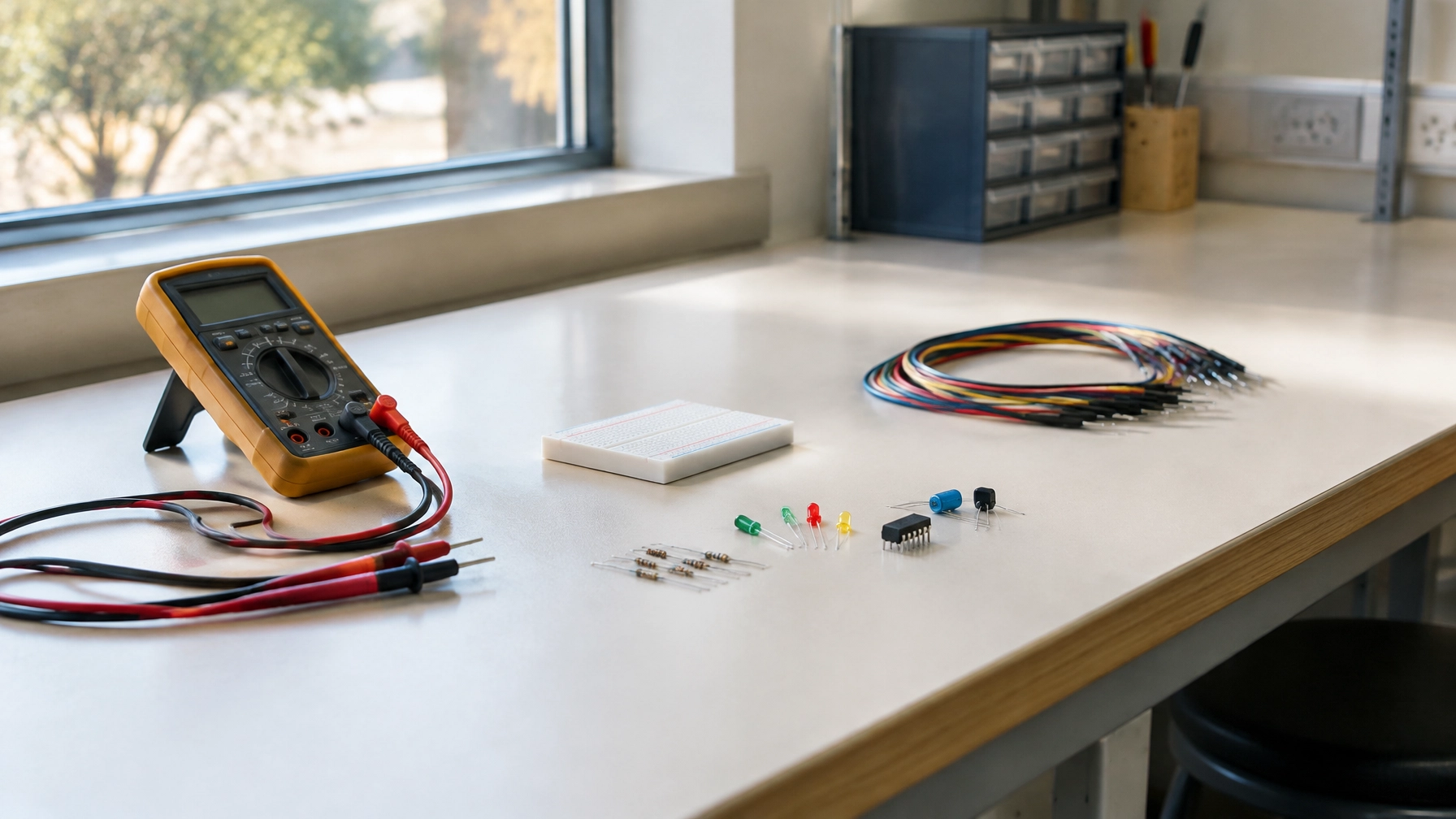
Put a circuit diagram in front of me, ask me to calculate the expected voltage across a component, and then have me verify it with a multimeter. Suddenly, my professional experience doesn’t provide all the answers.
I have to learn.
And I’m discovering that experience doesn’t mean I’ve stopped being a beginner.
Knowing About Something Isn’t the Same as Knowing How to Do It

In a recent lab, we explored resistance, reactance, and impedance.
I’d encountered these terms before. Resistance was reasonably familiar. Reactance and impedance were less so.
At first, I could follow the explanations. I understood enough of the vocabulary to feel that I was making progress.
Then I had to work through the calculations, connect the concepts, and explain what the measurements meant.
That’s where the real learning began.
Reading about resistance is one thing. Understanding why a circuit behaves as it does, predicting what a meter should show, and making sense of a different result is something else.
The distinction matters because familiarity can masquerade as understanding.
I’ve experienced this throughout my career. A presentation can make a complicated process seem straightforward. A well-designed dashboard can make it seem like we understand a business. A clear explanation can leave us feeling knowledgeable.
But can we explain the underlying relationships? Can we apply what we’ve learned when the circumstances change? Can we recognize when our assumptions are wrong?
Those questions reveal how much we actually understand.
Experience Can Help, but It Can Also Get in the Way

I didn’t return to school without useful experience.
Years of working in technology and operations have taught me to break complicated problems into smaller pieces, look for relationships, question assumptions, and work systematically toward an answer.
Those habits are valuable in an electronics lab.
But experience carries another risk: becoming accustomed to knowing what to do.
When you’ve spent years helping others solve problems, it can feel uncomfortable to be the person who doesn’t understand something.
There’s a temptation to move quickly toward the answer. To rely on familiar terminology. To assume that because you’ve encountered something before, you understand it well enough.
I’ve had to remind myself that returning to school isn’t to demonstrate what I already know.
It’s to develop capabilities I don’t yet have.
That requires a different relationship with uncertainty.
Rather than treating confusion as something to escape, I’m learning to treat it as information. It tells me where my understanding needs work.
Sometimes that means rereading an explanation. Sometimes it means asking a basic question. Sometimes it means discovering that my original calculation was wrong and working through it again.
None of these experiences is particularly glamorous.
All of them are useful.
Understanding Requires Participation

During a recent lab, I worked through electrical measurements and explored the relationships among resistance, reactance, and impedance.
The practical work pushed me to examine concepts more carefully than reading about them did.
That’s an important distinction.
I can read an explanation of a circuit and feel that I understand it. But when I have to calculate an expected result, make a measurement, and explain the difference between the two, I become responsible for my understanding.
I can’t simply recognize the correct answer. I need to know why it’s correct.
The same principle applies to the learning tools I use.
Artificial intelligence can help me explore unfamiliar concepts, explain terminology, check calculations, and organize my thinking. I find that genuinely useful.
But there’s a meaningful difference between using a tool to strengthen my understanding and using it to avoid developing that understanding.
If an AI system completes the reasoning, writes the explanation, and resolves every difficulty before I’ve wrestled with the problem myself, I may produce a better-looking assignment without becoming more capable.
That’s not what I want.
My goal isn’t simply to finish the lab.
It’s to become someone who can understand the circuit, use the instruments, identify a problem, and make an informed decision without depending on someone else to think.
The work matters because of what it develops in me.
Being a Student Is Changing How I Think About Teaching

There’s an interesting parallel between my experience as a student and my work as an English conversationalist and mentor.
Many of my English learners already know quite a bit of English.
They understand vocabulary, recognize grammatical structures, and can often follow complex conversations.
Yet when it’s their turn to speak, they hesitate.
They worry about choosing the wrong word, making a grammatical mistake, or expressing an idea imperfectly.
Sometimes they know much more than they’re comfortable demonstrating.
I recognize that feeling a little better now.
When I’m trying to understand an unfamiliar electrical concept, I want a clear explanation. I appreciate someone who can help me identify what I’m missing.
But I also need the opportunity to work through the problem myself.
If someone continually supplies the answer, I may feel supported without actually gaining independence.
The same is true for my students.
I can correct every sentence, suggest better vocabulary, and help them express an idea more naturally. Sometimes that’s appropriate.
But if I intervene too often, I risk making myself essential to a conversation they should increasingly be able to manage on their own.
Good teaching isn’t measured by how much the teacher contributes.
It’s measured, at least in part, by what the learner becomes capable of doing independently.
Being a student again helps me appreciate both sides of that relationship.
I want useful guidance. I also want room to struggle, experiment, make mistakes, and discover that I can work things out.
My students deserve the same opportunity.
The Value of Not Knowing

There’s another reason this experience matters to me.
At this stage of my life, I could reasonably focus on work that draws entirely on my existing experience.
I’ve spent decades developing professional capabilities. I could continue refining them, applying them in familiar environments, and relying on the judgment I’ve built along the way.
Instead, I’ve chosen to explore a more hands-on technical direction.
I don’t know exactly where that exploration will lead.
I may discover that I enjoy certain aspects of technical work more than others. I may find unexpected connections between electronics, automation, operations, and teaching. I may also find that the possibilities I’m exploring are less attractive in practice than they appeared from a distance.
That’s part of why I’m exploring them.
I’m not returning to school to prove that I can reinvent myself or to replace everything I’ve done before.
I’m here to find out what I enjoy, what I can learn, and what kinds of meaningful work might fit the next part of my life.
Doing that well requires being willing to encounter things I don’t know.
It also requires resisting the urge to turn every new experience into an immediate conclusion about my future.
Sometimes a lab is simply a lab. A difficult calculation is simply something I need to understand. A successful measurement is a small indication that I’m making progress.
Those experiences don’t need to justify an entire career decision.
They just need to help me learn.
Becoming More Capable

I’ve spent much of my professional life trying to make systems, organizations, and people more capable.
Returning to school has made that objective personal differently.
It’s easy to talk about learning, adaptability, and continuous improvement when you’re encouraging someone else.
It’s more revealing when you’re the person looking at a problem you don’t yet understand.
I’m learning that progress isn’t always about getting faster or becoming more efficient. Sometimes it’s about slowing down long enough to develop understanding.
It’s about asking another question when an explanation doesn’t make sense.
It’s about accepting correction without treating it as a judgment of your worth.
And it’s about recognizing that the uncomfortable space between not knowing and understanding is where much of the learning happens.
I still value the experience I’ve accumulated over time, from perspective, useful habits, and a foundation for approaching unfamiliar problems.
But I don’t want that experience to stop me from exploring.
Being experienced doesn’t mean I’ve finished being a beginner. It means I have more experience with what it takes to learn.
And right now, that’s exactly what I intend to keep doing.
Leave a Reply
You must be logged in to post a comment.