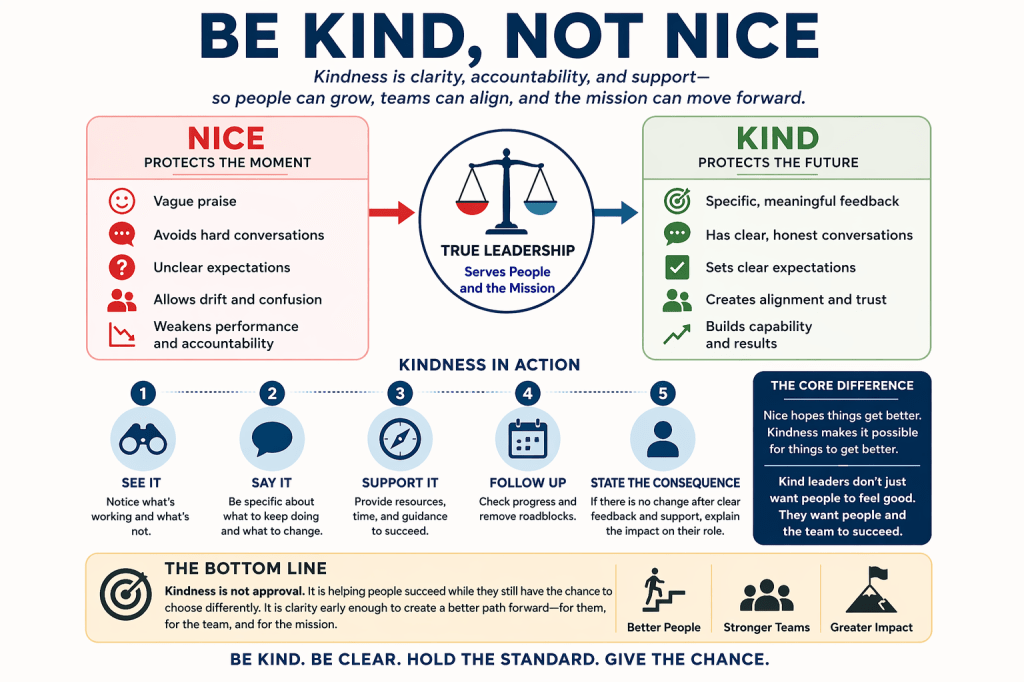
Many of us grow up believing that being nice is the right way to treat people.
- Be polite.
- Be encouraging.
- Avoid difficult conversations.
- Keep the peace.
Those instincts are not wrong. But in leadership, being nice and being kind are not the same thing. In fact, being nice for too long can quietly create confusion, weaker performance, and unfairness across a team.
That has been one of my hardest lessons.
Nice, Feels Good. Kindness Helps
Nice feedback often sounds supportive, but it lacks weight.
- Good job.
- Thanks for the effort.
- Let’s try to make more progress next week.
It protects the moment. It avoids tension. It sounds respectful.
But it often does not help someone repeat success. It does not help them correct what is off. It does not make expectations clearer. It leaves people with encouragement, but not direction.
Kindness is more specific.
- It says what worked.
- It says why it mattered.
- It says what needs to change.
- It says what happens if it does not.
Nice feedback is often empty. Kind feedback has consequences.
Specificity Is Respect
Kindness is not less supportive than niceness. It is more useful.
- When we thank someone specifically, we show that we were paying attention.
- When we clearly identify what they did well, we make it easier for them to repeat that behavior.
- When we explain what is not going well with enough detail to act on, we give them a real opportunity to improve.
That is respect.
Vague praise feels pleasant, but it does not reinforce much. Specific feedback gives someone something to hold onto.
In that way:
- Nice feedback: Praises output.
- Kind feedback: Builds capability.
Kindness Reinforces Process, Not Just Results
I have seen this recently in how I encourage people to use AI tools in their workflow.
Some team members still think they need to handle all the early brainstorming and outlining on their own. They fight brain fatigue, miss obvious themes, or get stuck trying to create a clean structure from scratch. A more effective approach is often to:
- Bring examples into an AI conversation.
- Explore possible directions.
- Go a little wild.
- Pick what is relevant.
- Shape the final work with human judgment.
When someone starts doing that well, I do not want to say only, “I like this.”
That is too thin.
What matters more is saying, “The way you brought this together works. Keep using that process.”
That reinforces not just the final product, but the way of working that produced it.
- Nice says, “This turned out well.”
- Kind says, “This approach is helping you do strong work. Keep going.”
One affirms. The other develops.
Where Niceness Starts Doing Damage
I have realized that one of the places I still drift toward niceness is in negative feedback.
I have no problem recognizing what people are doing well. I give specific gratitude. I encourage progress. I want people to succeed. But there have been times when I stopped short of being fully clear about what happens when needed progress does not happen.
I might say, “I’d like to see more progress in this area.”
That sounds reasonable. It sounds supportive. It sounds kind.
But sometimes it is still nice in the weaker sense. It does not name the consequence. It does not make the expectation weighty enough. It leaves too much room for someone to hear the feedback as optional.
And when that happens repeatedly, teams begin to diverge.
- The people who adapt, step up, use the tools around them, and respond to clearer expectations continue growing.
- The people who hang on, avoid change, or stay in old habits continue to drift.
If I do not clearly say what that means, I am not being compassionate. I am being unclear.
- Kindness: Protects alignment.
- Niceness: Protects comfort.
Invisible Expectations Become Team Problems
This shows up in small things that are not actually small.
Take status updates.
On the surface, not updating a status may look minor. But a team depends on shared visibility.
- If statuses are not updated, the team does not know where work stands.
- If the team does not know where work stands, it cannot tell whether priorities are on track.
- If leaders cannot see movement, they cannot support, redirect, or make good decisions early.
Now, imagine that one person in a more senior role stops consistently updating. Others start assuming that updating their status is optional. Then it is not just one person. It is a pattern. What looked like a small behavior becomes cultural drift.
That is why kindness has to make invisible expectations visible.
- Yes, you may be doing much of your job.
- Yes, your regular responsibilities may be mostly covered.
- But your role also includes stepping up, checking what is coming, taking ownership where appropriate, and helping the team stay coordinated.
If that expectation is real, then it needs to be said.
Supporting People Also Means Protecting The Mission
I want to support people. That is true personally and professionally.
I believe in:
- Helping people grow.
- Recognizing effort.
- Giving people room to learn.
- Giving people room to ask questions.
- Giving people room to stretch into work they do not yet fully own.
But leadership does not exist only to support the individual. It also exists to protect the shared commitment.
That is where “family nice” can get us into trouble.
Most of us want to be liked. Most of us want to believe the best of people. Most of us want to support others in becoming who they could be. But when someone consistently acts in ways that are not in the organization’s best interest, leadership has to say so.
Unless it is an ethics issue, the organization’s needs have to take precedence over my personal preferences.
That does not mean being cold. It means being honest.
If someone is no longer working toward the shared commitment, continuing to act as though they are aligned does not help them. It does not help the team either.
Consequences Are Not Cruel
This is the part I am still sharpening in myself.
I think I do fairly well at being kind to people. I support them. I explain paths forward. I try to be clear about what good work looks like. What I need to do better is explain the consequences when that kindness leads to repeated negative outcomes.
If we have had the conversation once, and then again, and support has been present both times, there comes a point when the next act of kindness is not more patience. It is clearer.
- This is the expectation.
- If it does not change, your role here will be affected.
- If it continues, we will need someone else in the seat.
That can feel severe when the immediate issue sounds small. But often the issue is not the surface behavior. The issue is what that behavior signals and what it permits others to normalize.
- A missed update is not only a missed update.
- A lack of ownership is not only a lack of ownership.
- A repeated failure to adapt is not only a slow learning curve; it is also a sign of a deeper problem.
These things shape trust, reliability, momentum, and culture.
Consequences are not the opposite of kindness. They are part of it.
Kindness Creates The Chance To Choose Differently
That is the core of it for me.
Being nice avoids the hard edge of reality. Being kind brings reality into the conversation while there is still time to act on it.
- Nice says, “I hope this gets better.”
- Kind says, “Here is what needs to change, and here is what happens if it does not.”
- Nice leadership: Tries not to upset people.
- Kind leadership: Gives people a real chance to succeed.
That is the shift I am continuing to make in myself.
I do not want kindness to stop at encouragement. I want it to include a consequence. I want it to remain supportive while also being honest enough to tell someone when their choices are starting to harm their growth, their role, or the team around them.
Because kindness is not approval.
Kindness is clarity: early enough, specific enough, and real enough that someone can still choose a better path.

Leave a comment