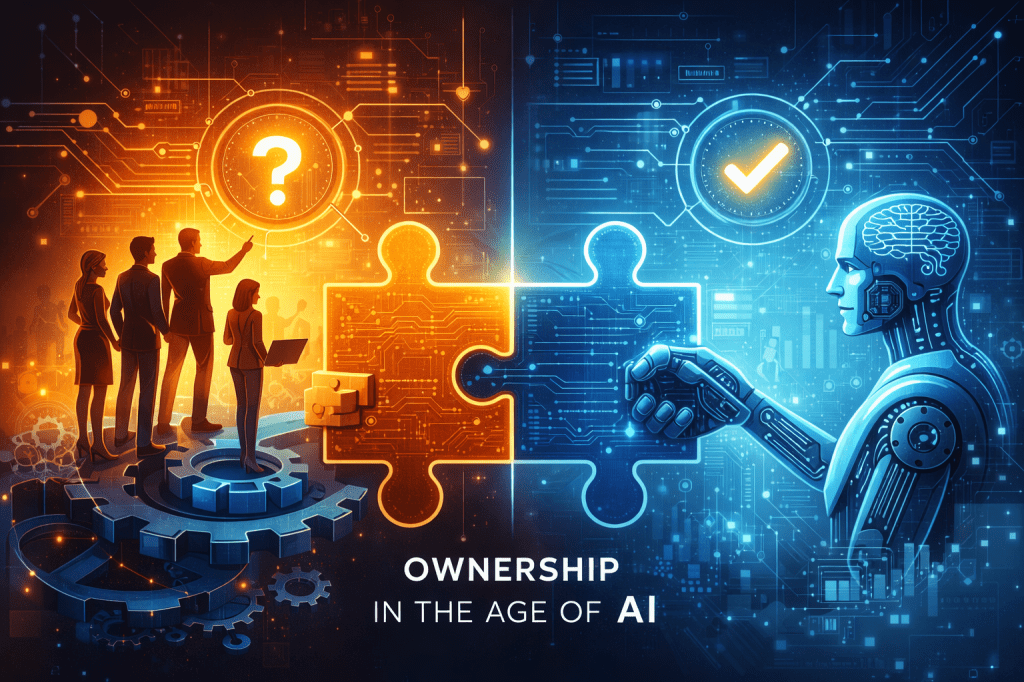
AI and automation are moving faster than most organizations know how to lead.
That is not a criticism of the tools. I believe in them. I use them. I have seen them save thousands of hours, reduce friction, and help teams shift their energy from repetitive work to more meaningful contributions.
Done well, automation can feel like breathing easier. It can create space for creativity, relationships, and better decisions.
But I keep seeing the same mistake.
Organizations are reaching for AI before they have done the harder work of clarifying ownership.
A leader wants better service pages, faster collateral, cleaner documentation, tighter operations, better conversion, and more consistency. All fair. All useful.
Then comes the next move: let’s use AI, let’s automate it, let’s move faster.
- What often gets skipped is the uncomfortable pause.
- What are we actually trying to accomplish?
- What problem are we solving?
- Whose job is it to define success?
- What decisions belong to leadership, and which ones belong to the people doing the work?
If those questions are fuzzy, AI does not rescue the situation. It accelerates the mess.
That is the heart of it for me: AI automation only amplifies what it is given.
If you give AI automation an unclear goal, you will get a polished piece of garbage. If you provide clarity about the boundaries, expectations, intent, and structure, you are far more likely to achieve consistent outcomes that reflect that quality of thinking.
The real challenge in the age of AI is not just adoption.
It is ownership.
Speed Is Not Clarity
There is a growing pressure in business to shorten every cycle.
What used to take two weeks now takes two days at most. What once required a thoughtful work session is now supposed to appear after a prompt and a workflow.
Leaders see what is technically possible, and the emotional expectations shift as well. If AI can draft, summarize, reformat, analyze, or generate, then surely the team should be able to deliver faster across the board.
Sometimes that is true.
Often it is incomplete.
Because speed is only useful when the direction is right.
A team can produce ten landing pages in record time and still miss the real market need. A workflow can publish polished collateral while quietly reflecting old service definitions. A content system can move faster than the business has aligned around what it actually sells or how it delivers.
In those moments, automation is not creating progress. It is creating volume.
That is why I keep coming back to a simple principle: effectiveness before efficiency. Make sure we are doing the right thing before we obsess over doing it faster.
That mindset shows up in both my leadership philosophy and my automation work because it protects people from burnout and protects organizations from scaling nonsense.
When leaders skip that step, teams feel it immediately. The request sounds urgent, but the outcome is vague. The deadline is clear, but the decision rights are not.
Everyone is moving, but not everyone knows where the finish line is.
That is not an AI problem.
That is a leadership problem.
How Ownership Quietly Breaks Down
When ownership is unclear, people start looking upward instead of outward.
A team member who should be solving a problem begins waiting for leadership to define the problem more precisely. A manager who should be enabling decisions starts asking executives for reassurance. A cross-functional team that could be iterating together pauses because they are unsure who is allowed to decide what.
The result is predictable.
Trust erodes, usually without anyone naming it.
If I hire someone to do a job but do not let them shape the work, I am telling them something, whether I mean to or not. I am telling them I trust their labor more than their judgment. That is a lousy message, and people hear it fast.
Once that happens, micromanagement becomes almost inevitable. Not because leaders are evil. Not because employees are lazy. Because the structure itself invites dependency.
People stop bringing their best thinking when they know someone above them will rework the approach anyway. They stop owning outcomes and start managing approval.
Then leaders get frustrated that the team is not more proactive.
That frustration is often self-inflicted.
If leaders hold on to the why, the what, and the how all at once, the team learns a simple lesson: do not risk independent judgment. Wait. Ask. Confirm. Escalate. That slows everything down and drains energy from the very people closest to the work.
And here is the irony: the leader pushing for faster, better, sooner may actually be the one making the system slower.
Ownership Belongs Closest to the Work
Leadership still matters. A lot.
But leadership has to be clear about where its authority is most useful.
In a healthy system, leaders provide a sense of purpose. They clarify why something matters, what boundaries exist, what success should look like, and what constraints cannot be ignored. They set intent. They establish direction. They may offer context from past experience. They may surface tradeoffs the team should keep in mind.
What they should not do is own every detail of the solution.
The people closest to the work need room to define the real need, map the relevant process, test assumptions, and determine the best path forward. Managers should work with their teams. Teams should collaborate across functions. The people responsible for delivery should have meaningful authority over how it is delivered.
That is not a soft idea. It is an operational one.
AI and automation make this more important, not less.
The tools are evolving too quickly for leaders to pretend they can prescribe every effective method from a distance. The smartest approach often comes from the people experimenting in the work itself: the marketer adjusting messaging, the HR lead redesigning experience flows, the operations person spotting friction, the engineer translating needs into systems.
Leadership should not disappear. It should mature.
The role shifts from director to supporter, from decider of every method to steward of clarity.
That is real ownership.
What Healthy Ownership Looks Like
I have seen this work best when teams are given enough safety and enough structure to iterate.
Take onboarding as an example.
When HR is trusted to rethink onboarding, work with technology partners, test ideas, gather feedback, and improve over time, the output gets better in ways leadership alone could not have designed.
Version 1 gets the basic experience into motion. Version 2 reveals what new hires still find confusing. Version 3 becomes far more cohesive because it reflects lived learning rather than assumptions from above.
Then the whole experience changes.
New hires receive information proactively. They understand the company sooner. They meet the right people earlier. Their role is clearer. Their support system is clearer. The process begins to feel intentional rather than accidental.
That better outcome is not just the result of a smart workflow.
It is the result of ownership.
The people closest to the problem were allowed to solve it. They were trusted to collaborate. They had enough time to move from rough draft to useful system. They were not asked to produce perfection on day one. They were allowed to build, reflect, and refine.
That same pattern shows up in teaching, leadership, and process design more broadly.
If I am part of the conversation, the other person may answer me, but they will not really own the exchange. If I create enough structure for them to participate safely, they begin contributing in a real way.
The same is true for teams. Give people model questions, useful boundaries, and room to think together, and they often do better work than when every answer is handed to them.
Ownership grows when people are trusted to shape outcomes, not just execute tasks.
What Leaders Need to Stop Doing
The age of AI is forcing a leadership reset.
Not because leaders are suddenly irrelevant. Because the old habit of controlling too much becomes even more costly when tools move this fast.
Leaders need to stop prescribing the exact process when the team is better positioned to discover it.
They need to stop demanding immediate answers to problems that require thought, testing, and discussion.
They need to stop changing expectations midstream without acknowledging the cost of that shift.
They need to stop measuring visible activity as if it were the same thing as progress.
And they need to stop expecting a final answer when what the moment actually requires is iteration.
A smarter posture looks different.
The leader names the purpose. The leader clarifies the desired outcome. The leader writes down the success criteria. The leader makes time and space for research. The leader joins conversations as a curious stakeholder, not as the automatic subject matter expert. The leader becomes available to provide context, support, and remove obstacles.
Then the leader backs off enough for ownership to exist.
That last part matters.
If people never have the freedom to determine the what or the how, they will not bring full energy to the problem.
Why would they? Buy-in comes from contribution. Commitment grows when people help shape the path, not when they are merely handed instructions disguised as collaboration.
This is one reason iterative development matters so much right now. We need more version 1, version 2, version 3 thinking. More MVPs. More learning loops. Less theater around instant perfection.
AI makes iteration faster, which is useful. But leaders still have to create the conditions that allow iteration.
Trying to invent a new way of working today and launch it tomorrow might sound decisive. Most of the time, it is just shallow.
Good systems take thought. Good ownership takes trust. Good outcomes take a bit of time.
AI Will Scale Whatever Culture You Already Have
This is the uncomfortable truth many organizations want to skip.
AI does not fix culture.
It exposes it.
If your organization is vague about goals, AI will produce vague output at scale.
If your teams are afraid to make decisions, automation will not make them braver.
If your leaders change direction every few days, no prompt library on earth will create stable results.
If trust is weak, clarity is weak, and ownership is trapped high in the hierarchy, AI will simply help the dysfunction move faster.
The reverse is true too.
If leaders are clear about purpose and boundaries, teams can make better decisions.
If the people closest to the work are empowered, automation can reduce friction without reducing accountability.
If shared knowledge is strong, AI can help teams become more resilient rather than more dependent.
That is why this conversation belongs as much in leadership and culture as it does in technology. Sustainable systems are built on vision alignment, accountability, empowered decision-making, resilience, trust, and shared knowledge, not just tooling.
Ownership is not some nice extra after the workflow is built.
It is the operating condition that determines whether the workflow becomes useful or wasteful.
The Leadership Test
Here is the test I would offer any leader pushing AI adoption.
Can your team clearly explain the outcome you want, the boundaries that matter, the decisions they own, and how success will be judged?
If not, stop asking for faster output.
Get clearer first.
Can your team shape the method, question assumptions, and improve the process without needing your approval every few hours?
If not, you do not have an automation problem. You have an ownership problem.
Can people make mistakes, learn, and adjust without fearing that one imperfect version will be treated as a failure?
If not, AI will only scale hesitation.
Technology has changed. Human responsibility has not.
Leaders still need to provide purpose. Teams still need trust. Organizations still need clarity. Systems still need iteration.
The companies that thrive will not be the ones that merely buy the most tools. They will be the ones who know how to distribute ownership well.
That is the work.
AI can draft, analyze, summarize, and execute faster. But it cannot care on your behalf. It cannot align people on your behalf. It cannot decide what matters most to you. It cannot replace the discipline of defining why something should exist and who should own it.
AI automation only amplifies what it is given.
Give it confusion, and it will scale confusion beautifully.
Give it clarity, trust, boundaries, and responsible ownership, and it can help people do some of their best work.
That is not just a technology strategy.
That is leadership.

Leave a comment