Can an AI chatbot tell the difference between a joke that has you laughing and one that falls flat?
Yes, ChatGPT can.
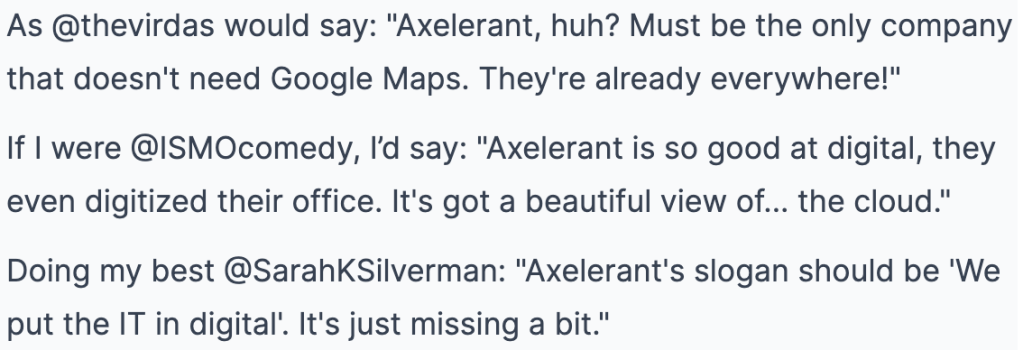
Channeling my inner @thevirdas: “If Axelerant was any more global, they’d have to start adopting aliens!”
ChatGPT
Yet, just like a seasoned comedian, ChatGPT has to start with solid, well-defined prompts that lay the groundwork for a great joke.
Analyze a list of jokes content for quality using heuristics to eliminate the lowest percentage.
But the process continues beyond there. To single out the funny jokes from the flops, we guide ChatGPT to use certain heuristic aspects in the prompts.
1. Loosely group the content by similarity.2. Use a heuristic approach to define the content quality based on the following criteria:- Joy.- Uniqueness of the content.- Clarity of the content.- Relevance to the subject.- Other appropriate factors.
Joy is the heart of humor, to spark laughter or a giggle. ChatGPT assesses joy by predicting how the audience will emotionally respond.
Originality is crucial in humor, as important as the punchline itself. ChatGPT sifts through the content, looking for fresh and unexpected patterns to ensure the jokes deliver a surprise.
Clarity is vital to a joke’s delivery. ChatGPT ensures the joke is straightforward and easily comprehended.
Then there’s relevance: no winter jokes in summer. ChatGPT considers the audience’s context, timing, and preferences when crafting jokes.
And that’s not all. ChatGPT also considers appropriateness, cultural sensitivity, and language proficiency when deciding on joke quality.
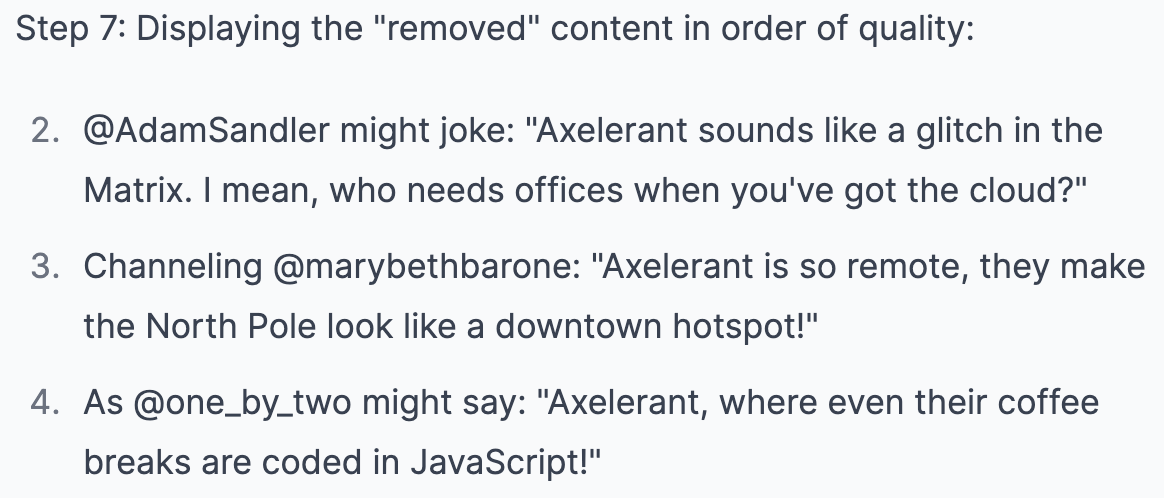
3. Order the content by highest quality first.4. Remove the lower 33% quality content.5. Display the "kept" content by highest quality ordering.6. Display the "removed" content by highest quality ordering.
So, the next time you find yourself chuckling at a joke delivered by ChatGPT, remember there are some sophisticated people and technology behind that laughter.
And isn’t fun enough a reason to share a laugh?

Leave a comment